November 8, 2026
Failing the 0.7% Target: The Decline of Global Aid and its Impacts
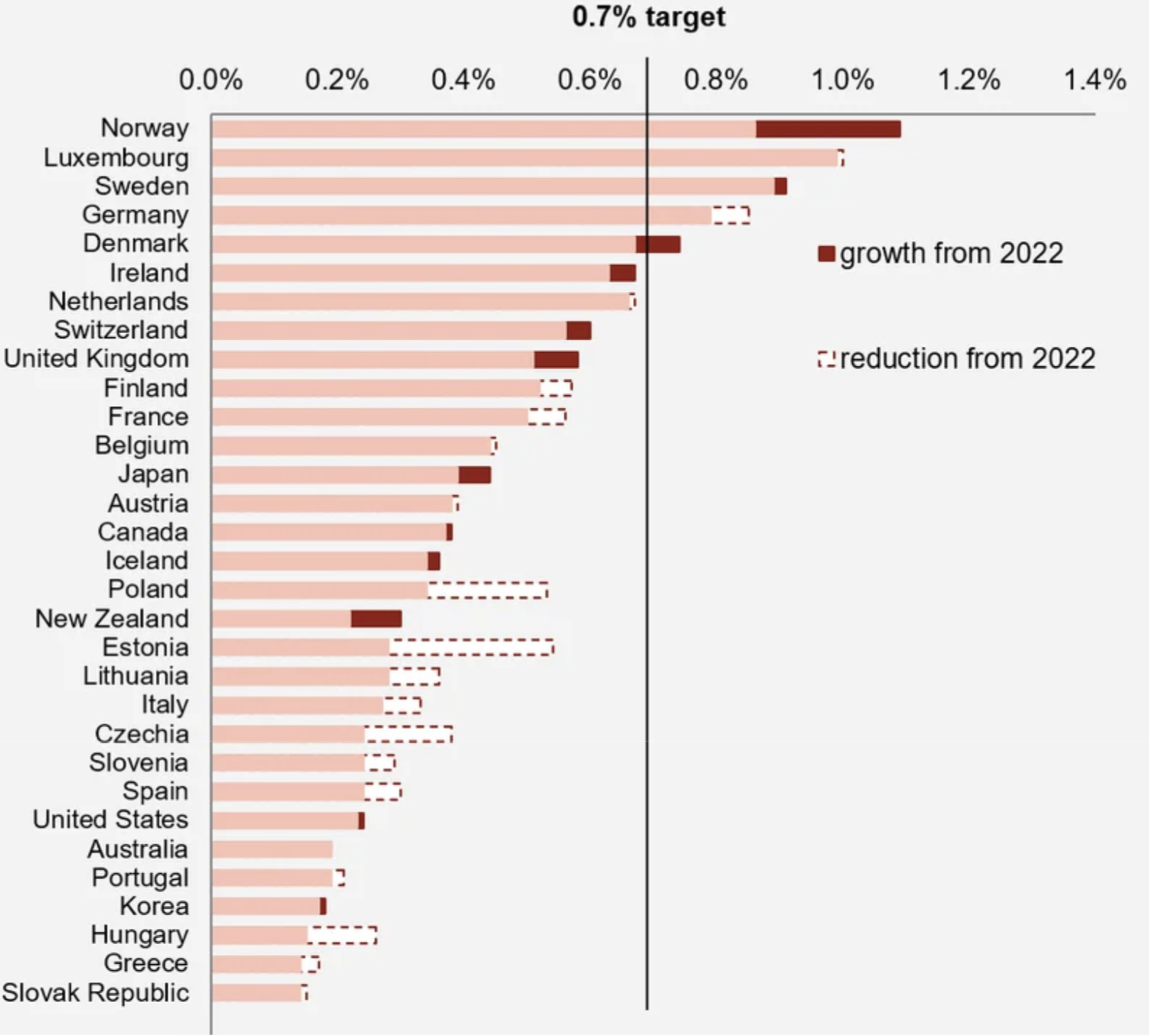
Photo credit: OECD DAC
Official Development Assistance (ODA), or aid funds, are a part of government aid which nations may choose to participate in. They are crucial to stimulating economic growth and promoting welfare for underdeveloped communities. This article introduces understanding of the process behind them, the impacts and responsibilities for recipient governments, and the reasons for their recent reduction.
Above is a bar chart representing the change since 2022 in a select group of More Economically Developed Countries’ (MEDCs) donated aid funds as a percent of their GNI. The new aid data highlights1 that only a handful of nations which are significant participants meet the 0.7% of GDP recommended target set by the UN. Furthermore, trends show that many nations are regressing rather than progressing toward the target, in particular Estonia and Poland.2
In a period of time, after the data above was collected, some of the most significant regressions took place. During the second Trump administration, the United States integrated the US Agency for International Development (USAID) into the Department of State resulting in a 57% reduction in ODA during 2026 alone.3 The UK, who as recently as 2021 were meeting the threshold, recently dropped their ODA to 0.3% of the GNI.4 Sweden is projected to fall below the 0.7% target for the first time in 35 years, with an approximate 26% cut to foreign aid with contracts terminated primarily for countries in Africa and Latin America.5
The reasons for their previous provision were primarily political, and the reasons for their termination, however, are also driven by national demographics. Most MEDCs are facing economic decline driven by ageing populations and therefore a lack of a work force; in addition to the fact that development cooperation may not be as relevant for a national agenda especially for countries such as the US.6
To understand this issue and their casual factors, the process and terms associated with aid funds need to be understood. There are two types of aid; tied and untied. The terms for tied aid are often set by the donor nation, while united aid can be spent however the recipient country wishes to, with some limitations. However, ‘Official’ Development Aid often is not approved and therefore can be strategically exploited by donor nations.
The International Aid Transparency (IATI) was established in the first place to prevent this. Acting as a publishing of aid funds and their measurable results, it is rarely used, highlighted by generally abysmal numbers in the ‘Publish What You Fund’ scoring index.7 The primary economic factor which drives these cuts lie in the expensive assessment process which is associated with the publishing.8 Furthermore, governments such as the People’s Republic of China cite that their ‘off the books’ methods increase aid effectiveness without violating national sovereignty.
Therefore, aid funds which do not classify under ODA are generally first organized through a multilateral organization which receives the funding from the donor nation. After that, recipient governments, NGOs or local organizations are relegated with funding to create tangible impact. When this process is not heavily monitored, corruption or miscommunication at each level lead to lower aid effectiveness. Furthermore, corruption can be internationally induced by donor nations so as to win favors which are backed with the threat of terminating further funding. Cases such as the UK and Sweden, which did have a high score on indexes, show that the current official ODA systems in place are not sustainable for MEDCs to continue to participate in considering their demographical regressions.
The political and demographic viewpoints have wrought adverse effects in LEDCs, especially for governments that relied on ODA previously, in particular for medical assistance. In an estimation by ImpactCounter, the US$12.7 billion of terminated funds by USAID alone attributed to over 170,000 deaths in the last year.9
The medical field is not the only sector to be affected. Roughly 735 million people are expected to be affected by agricultural sector cuts and could face hunger, malnutrition, and possibly famine. Furthermore, more than 6 million children are estimated to be out of school by 2027 due to educational sector cuts.10
By Vivaan Gujarathi
1: “New Aid Data Highlights Ongoing Global Challenges.” 2025. Devinit.Org. May 4, 2025. https://devinit.org/what-we-do/news/new-aid-data-highlights-ongoing-global-challenges/.
2: OECD DAC
3: Gichuki, Lydia. 2026. “One Year on: What the Collapse of USAID Has Cost the World.” DevelopmentAid. May 13, 2026. https://www.developmentaid.org/news-stream/post/206934/what-the-collapse-of-usaid-has-cost-the-world.
4: Neill-Eagle, Tom. 2026. “The UK Aid Cuts: Was the Reduction From 0.7% To 0.5% Of GNI Inevitable, and Should Charities Have Fought Harder?.” Plinth. April 4, 2026. https://www.plinth.org.uk/debates/uk-aid-cuts.
5: Wassholm, Christina. 2026. “Sweden Makes Further Cuts to International Development Assistance – CONCORD Sverige.” CONCORD Sverige. January 7, 2026. https://concord.se/sweden-makes-further-cuts-to-international-development-assistance.
6: https://www.euronews.com/2026/04/14/foreign-aid-plummets-in-europe-which-countries-are-slashing-their-funds
7: “Methodology - Publish What You Fund.” 2016. Publish What You Fund. November 30, 2016. https://www.publishwhatyoufund.org/the-index/methodology/.
8: “Phantom Aid.” 2026. In Wikipedia. https://en.wikipedia.org/w/index.php?title=Phantom_aid&oldid=1380712407.
9: Gichuki, Lydia. 2026. “One Year on: What the Collapse of USAID Has Cost the World.” DevelopmentAid. May 13, 2026. https://www.developmentaid.org/news-stream/post/206934/what-the-collapse-of-usaid-has-cost-the-world.
10: Gichuki, Lydia. 2026. “One Year on: What the Collapse of USAID Has Cost the World.” DevelopmentAid. May 13, 2026. https://www.developmentaid.org/news-stream/post/206934/what-the-collapse-of-usaid-has-cost-the-world.